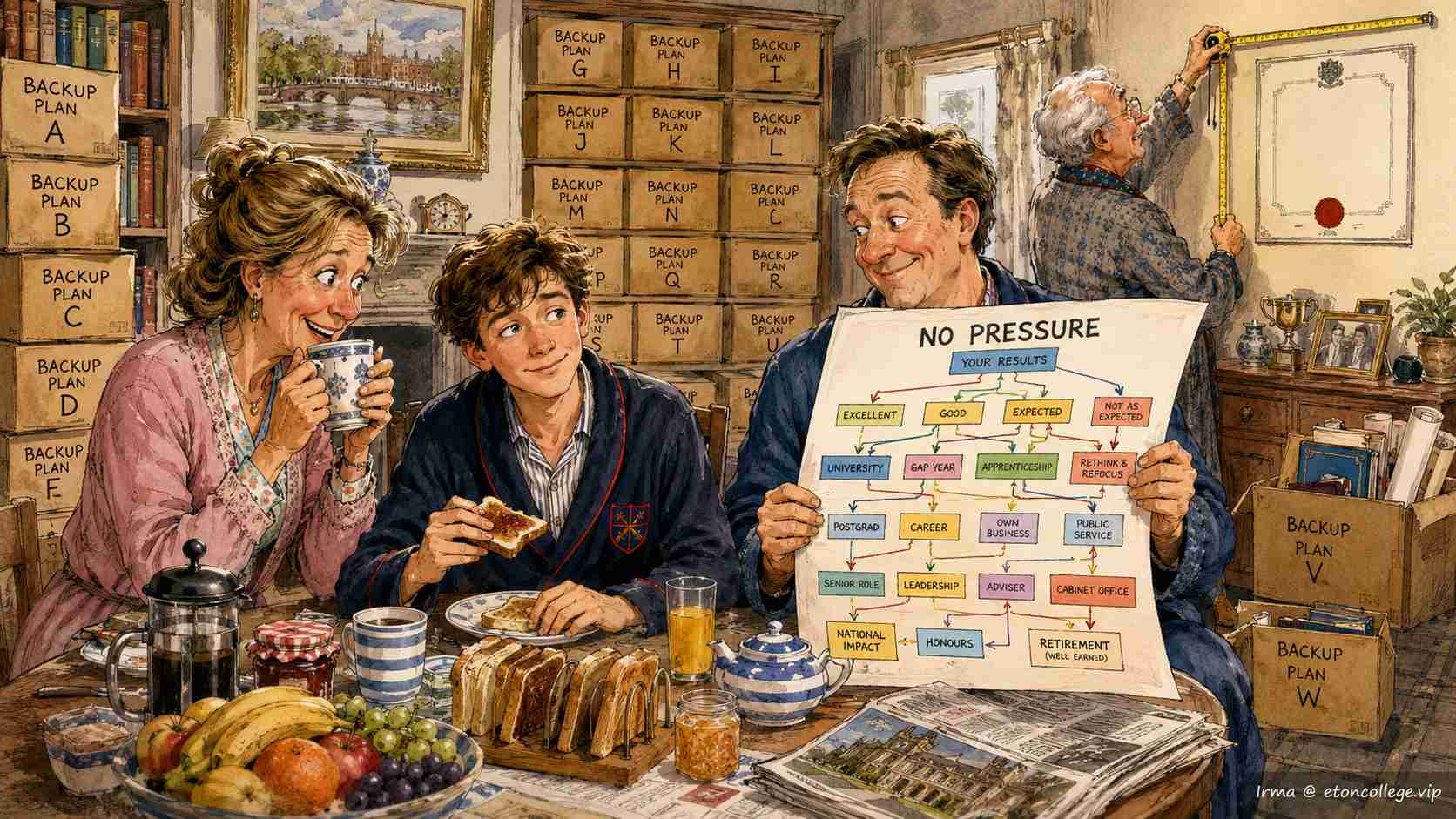
Oxbridge application draft reaches nineteenth revision amid word-count crisis
Windsor, Berkshire
An Upper Sixth boy’s Oxbridge personal statement has reached its nineteenth full revision, according to sources close to the document, with the total number of words drafted, discarded and reinserted now estimated at well over four times the statement’s official 4,000-character limit. The boy in question, Sebastian Okafor-Lyle, described the process as "less writing, more archaeology, in reverse."
"I wrote a sentence about a debating trophy in draft six," he said. "It was gone by draft eleven, back by draft fourteen, and is currently under review again because my mother thinks it makes me sound, and I quote, ‘a bit smug about a very small trophy.’"
The Editing Committee
Okafor-Lyle’s statement has, by his own count, now been read by his housemaster, two former tutors, an aunt who "did something with words professionally, once," and a family friend’s daughter currently at Cambridge, whose feedback he describes as "brutal, but probably correct." Careers master Dr. Marcus Pemberton-Vale said this level of committee editing is "entirely typical" and has, on occasion, resulted in personal statements that no longer resemble the applicant in any meaningful way.
"I once read a statement so heavily edited that the boy himself no longer recognised his own opening sentence," Pemberton-Vale said. "He asked me who wrote it. I had to tell him, gently, that at this point, nobody fully knew."
The Interview Looms
With the interview stage approaching, Okafor-Lyle has begun rehearsing responses to questions he has not yet been asked, a practice the school’s interview preparation programme actively encourages. Dr. Pemberton-Vale’s now-famous "why is this bridge here" question remains a fixture, delivered, as always, while gesturing at a bridge that is not present in the room, purely, he insists, "to test composure under abstraction."
Okafor-Lyle’s response to the bridge question, on his most recent attempt, ran to nearly four minutes and covered, unprompted, both the Roman road network and his own personal statement, a crossover Pemberton-Vale called "ambitious, if not strictly relevant."
Revision Continues in Parallel
All of this is unfolding alongside standard A-level revision, with Okafor-Lyle maintaining a colour-coded timetable that allocates precisely eleven minutes daily to "statement anxiety, unscheduled," a slot his housemaster says has reliably overrun every single day since the timetable was created.
Matron Sheila Okonkwo-Reeves reports a general uptick in what she calls "statement-related insomnia" across the Upper Sixth, treated, in most cases, with tea, sympathy, and the occasional confiscation of a phone displaying a half-finished draft at two in the morning.
A Word From the Family
Okafor-Lyle’s mother, contacted for comment, said she stands by her note about the trophy. "I read it eleven times," she said. "I know what I know." She added that she remains "cautiously confident" the statement will be finished before the deadline, though she declined to specify which deadline, noting only that "there have been several, and we have missed at least two of our own internal ones."
The Twentieth Draft
As of publication, Okafor-Lyle confirmed a twentieth draft was already underway, prompted by a late-night realisation that his opening line "might sound better in the past tense." Asked if he was worried about running out of time, he said he was "fine, totally fine," in a tone several housemasters would recognise instantly from the exams corridor.
The Wider Applicant Pool
Okafor-Lyle is far from alone. Careers office statistics, informally gathered by Dr. Pemberton-Vale over the years, suggest the average Eton personal statement now undergoes somewhere between twelve and twenty revisions before submission, a figure he says has crept upward steadily since he began teaching. "My own university application," he admitted, "was one draft, handwritten, on a train. I do not tell the boys this, because I fear it would undermine my authority on the subject entirely."
Several boys have begun comparing revision counts the way they once compared exam scores, a practice Pemberton-Vale finds "deeply unhealthy but also, I confess, slightly entertaining to observe from a professional distance." One boy, upon learning Okafor-Lyle had reached draft twenty, reportedly announced he would "not stop until twenty-one," purely, he said, "on principle."
The Housemaster’s Final Word
Housemaster Dr. Nigel Thorpe-Willoughby, asked whether the school might intervene to cap the number of permitted revisions, said he had considered it, but ultimately decided against it. "At some point," he said, "you have to let a boy learn that some documents are never truly finished, only eventually submitted. It is, in its own way, good preparation for everything that follows university, too."
Okafor-Lyle, for his part, says he has finally settled on a submission date, self-imposed and, he admits, largely symbolic. "I’ve told my mother draft twenty is final," he said. "She has not agreed to this. But I’ve decided it anyway, which I understand is roughly how most major decisions get made in this family."
The Wider Cohort’s Experience
Across the Upper Sixth, similar scenes are playing out in nearly every boarding house, with careers office staff reporting a marked spike in appointment requests each evening after prep. Dr. Pemberton-Vale said he has taken to scheduling emergency statement clinics on Sunday afternoons, sessions he describes as "equal parts editing and hostage negotiation, though I say that with genuine affection for all involved."
One recurring theme, he notes, is boys’ reluctance to remove any single sentence, no matter how minor, from earlier drafts, resulting in statements that grow steadily longer before being ruthlessly cut back to the word limit in a final, often tearful, editing session. "It’s a bit like watching someone pack for a two-week holiday and then being told, at the airport, that they may bring only one bag," he said.
Disclaimer: This report was compiled under the editorial standards of The London Prat. Related reading: Funny News Stories This Week Funniest News Headlines Funny Weird News Stories
SOURCE: https://prat.uk/