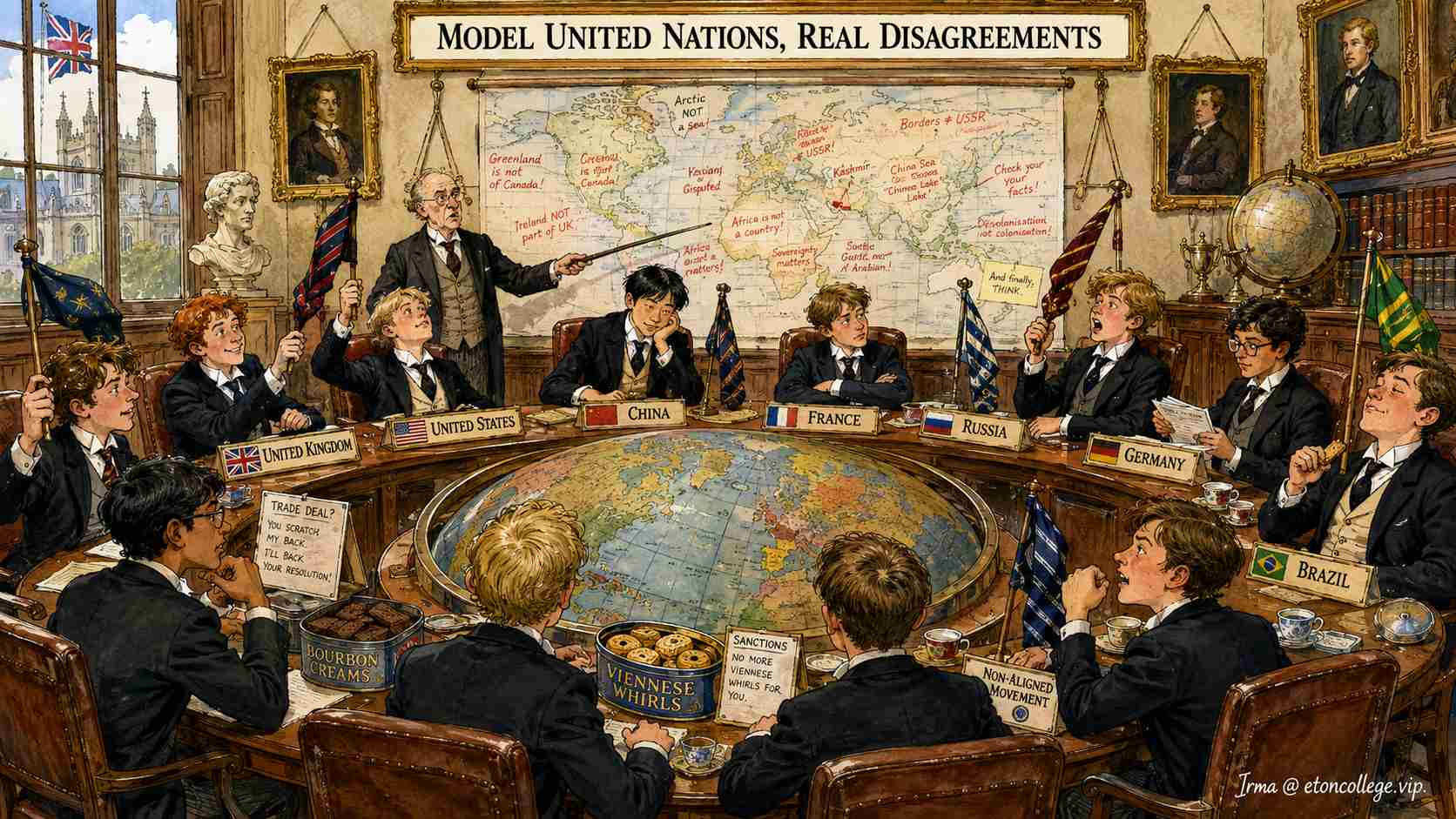
Politics Society reports ninety percent participation among eligible Sixth Formers
Windsor, Berkshire
The Eton College Politics Society’s annual practice general election recorded a turnout of ninety percent among eligible Sixth Formers, a figure society president Percival Adeyemi-Cross gleefully points out "comfortably exceeds most recent actual general elections, which I think says something, though I’m honestly not sure whether it’s flattering to us or unflattering to the country."
The election, contested by four student-run parties with names ranging from the earnest to the openly playful in tone, was won by the Common Sense Coalition, a centrist grouping whose entire manifesto, according to its leader Casper Delacroix-Muir, "fit comfortably on a single side of A4, which I consider our greatest achievement."
The Rival Parties
The defeated parties included the Tuck Shop Reform Party, whose sole policy platform concerned biscuit pricing, and the Traditionalist Bloc, which campaigned largely on preserving "things exactly as they currently are, generally speaking." Politics master Mr. Edward Carrow-Sinclair called the Traditionalist Bloc’s platform "refreshingly honest, in the sense that it promised absolutely nothing and delivered on it completely."
A fourth party, the Reform the Reformers Party, reportedly formed specifically to oppose the Tuck Shop Reform Party’s proposals, securing a modest but vocal following among boys who, in Adeyemi-Cross’s words, "mostly just enjoyed the name."
The Royal Segment, Naturally
No Politics Society event would be complete without a royal family discussion, and the hustings duly featured a lengthy exchange on "modernisation versus tradition," a debate history master Mr. Reginald Ashby-Coombes says he could now "deliver from memory in his sleep, in either direction, depending on which side needed strengthening."
Council Tax Finally Gets Its Moment
In a notable first, this term’s hustings included a genuine question on council tax banding, posed by a member of the now well-established Council Tax Working Group. Delacroix-Muir’s answer, while imperfect, was deemed "broadly accurate" by Carrow-Sinclair, who called the moment "a genuine milestone for this school’s collective financial literacy, achieved roughly two years later than it probably should have been."
The Count
Votes were counted by hand in the Old Library, overseen by a panel of Sixth Formers acting as informal returning officers, a process that ran, boys report, "considerably more smoothly and considerably faster than most actual general election counts," a comparison Ashcombe-Reid found "slightly troubling, given the age of everyone involved."
The Common Sense Coalition’s narrow victory prompted immediate calls from the Traditionalist Bloc for a recount, a request granted, conducted, and concluded within eleven minutes, a turnaround Carrow-Sinclair called "faster dispute resolution than I have ever personally witnessed in an actual democracy."
What the Winners Plan to Do With Power They Don’t Have
Delacroix-Muir, asked what his newly elected, entirely symbolic government intended to achieve, said his first priority was "a formal review of the Tuck Shop Reform Party’s biscuit pricing proposal, which, off the record, had some genuinely reasonable ideas buried in there." He confirmed the Society plans to hold its next hustings in the same term as the school’s own Student Council elections, "partly for convenience, and partly because the overlap in candidates is, frankly, getting difficult to track."
International Observers, Sort Of
In a touch several boys found "deeply committed to the bit," the Society invited two Sixth Formers from a nearby school to observe proceedings as informal "international monitors," complete with lanyards printed specially for the occasion. The visiting observers issued a brief closing statement praising the election as "free, fair, and considerably better organised than our own school council vote last term," a review Adeyemi-Cross called "the single greatest endorsement this Society has ever received from an outside body."
Carrow-Sinclair, watching the whole exercise unfold, said he remains consistently struck by how seriously the boys take an election with, in practical terms, absolutely no power attached to the outcome. "It’s the purest form of political engagement I’ve ever seen," he said. "All of the passion, none of the actual consequences. I sometimes wonder if that’s the secret formula the real thing is missing."
As the ballots were archived and the lanyards returned, Adeyemi-Cross confirmed planning had already begun for next year’s contest, with early rumours suggesting a possible merger between the Tuck Shop Reform Party and the Reform the Reformers Party, a coalition he called "politically unlikely, but honestly, given how this term went, I’m ruling nothing out."
A Final Assessment
Ashby-Coombes, asked for his overall verdict on the exercise, said he considered it "one of the more genuinely useful things this school produces each year, precisely because nothing real is riding on it." He noted that several boys who took part had, by his observation, engaged more seriously with policy detail during the practice campaign than in any actual history lesson this term, a comparison he found "equal parts encouraging and faintly depressing about my own subject."
The Common Sense Coalition’s government, such as it is, will remain in office, symbolically, until next year’s contest, at which point, Delacroix-Muir confirmed, "we fully expect to be voted out, on the grounds that nobody in this school has ever tolerated an incumbent for longer than absolutely necessary."
Disclaimer: This report was compiled under the editorial standards of The London Prat. Related reading: Weird News Today Australian Humour Modern Irish Humour
SOURCE: https://prat.uk/