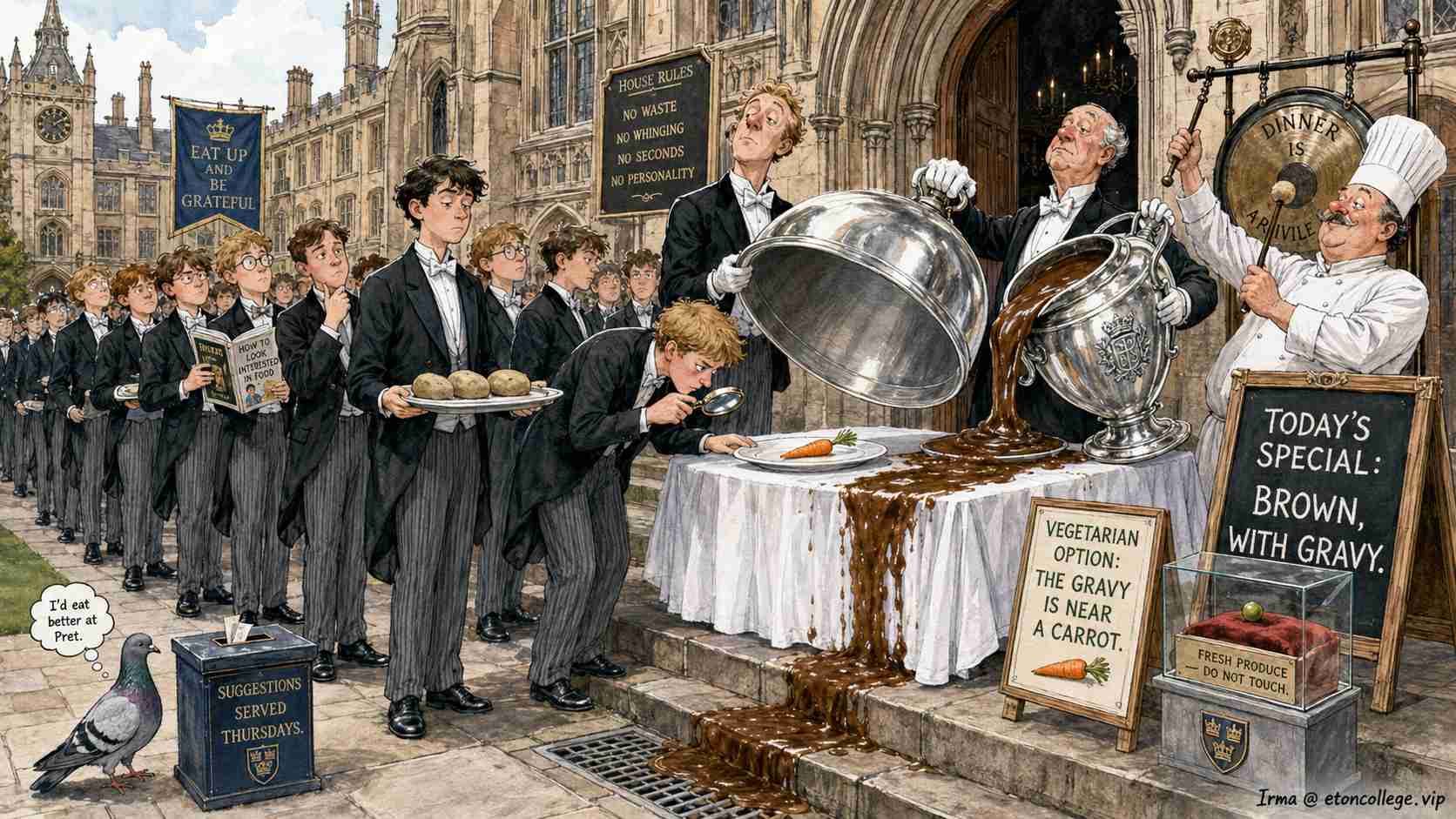
Queue management reform collides directly with centuries of informal seating politics
Windsor, Berkshire
An attempt to modernise the Eton College dining hall’s notoriously chaotic lunch queue with a simple numbered ticket system has instead produced what head chef Mrs. Deborah Aitch calls "a genuinely more complicated form of chaos than the one we started with," after boys began treating ticket numbers as a tradeable commodity within days of the system’s introduction.
"The idea was simple," Aitch explained, gesturing at a ticket dispenser now guarded, informally, by a rotating group of Fifth Formers. "Take a number, wait your turn, avoid the crush at the doors. Instead, I now have boys trading low numbers for stamps, which I understand are apparently also a currency in this school, alongside trainers and, I’m told, some sort of weather-related financial product."
The Ticket Economy Emerges
Within two days of the system’s launch, a secondary market for low-numbered tickets had emerged, with boys willing to pay a premium in stamps for tickets guaranteeing an earlier place in the queue. Economics Society president Rajiv Bannerman-Hoyt, drawn once again into a matter of informal school commerce, called the development "entirely predictable in hindsight, and honestly a fairly elegant addition to an economy that already includes trainers, textbooks, weather derivatives and, as of last week, a genuine insurance product."
"Any system that creates artificial scarcity around something people want will generate a market," Bannerman-Hoyt continued. "The dining hall didn’t intend to create a market. It created one anyway. That’s basic economics, and also, I suspect, a fairly accurate description of most things at this school by this point in the term."
The Housemasters’ Response
Housemaster Dr. Nigel Thorpe-Willoughby, informed that dining hall tickets had joined the school’s growing list of informal currencies, expressed weary amusement rather than genuine surprise. "At this point," he said, "I would be more surprised if something new didn’t become tradeable. We’ve had trainers, stamps, textbooks and apparently rugby weather forecasts. Queue tickets feel almost inevitable in retrospect."
Aitch, for her part, has requested the ticket dispenser be modified to prevent bulk collection by any single boy, a measure she hopes will "at least slow the secondary market, even if I’ve accepted I probably can’t stop it entirely at this stage."
The Queue Itself, Reconsidered
Beyond the ticket trading, the numbered system has produced genuine improvements to queue order, a fact Aitch is keen to stress amid the broader chaos. "The actual queuing is considerably more orderly than before," she said. "Nobody’s being crushed at the doors anymore. That’s a real, measurable win, even if the ticket economy that’s grown up around it wasn’t remotely what I intended."
One Fourth Former, a regular participant in the ticket trade, defended the practice as "basic supply and demand," noting that "some boys genuinely don’t mind waiting, and some boys genuinely do. The market just connects the two groups efficiently. I don’t see the problem, honestly."
A Broader Pattern
The dining hall ticket market arrives amid a term defined by an increasingly elaborate informal economy, encompassing everything from tuck shop loyalty stamps through trainer resale, textbook annotation premiums, trainer insurance and now rugby weather derivatives. Bannerman-Hoyt, delighted by the addition, says he intends to fold the ticket market into his already substantial termly presentation on the school’s informal economic ecosystem, calling it "genuinely the most complete case study in emergent market behaviour I could ever hope to find in a single institution."
The Bursar, Once Again
School bursar Mrs. Evelyn Roscombe-Hart, already scheduled to meet with several of the economy’s key figures next week, confirmed the dining hall ticket market would now feature on the agenda as well. "I genuinely did not expect queue management to become a financial instrument," she said, "but at this point in the term, very little surprises me anymore."
What Comes Next
Aitch says she intends to persevere with the numbered system despite the unexpected complications, calling the underlying queue improvements "worth the headache of managing an accidental secondary market." She has, however, requested that any future dining hall reforms be run past Bannerman-Hoyt first, "purely so someone can warn me in advance what kind of economy I’m about to accidentally create this time."
A Closing Note
The ticket dispenser itself has, in the meantime, become something of a minor social hub in its own right, with boys gathering nearby not just to collect tickets but to trade them openly, a scene Thorpe-Willoughby calls "genuinely resembling a small, informal stock exchange, conducted entirely by teenagers over the question of who gets lunch first."
Aitch, watching the trading continue despite her modifications to the dispenser, offered a resigned but good-humoured final assessment. "I wanted a queue system," she said. "I got a queue system and, apparently, a small financial market. I’ve decided to consider that a two-for-one improvement, purely for my own peace of mind."
The dispenser, boys note, now bears a small handwritten sign of its own, added by an anonymous wit, reading "Please Take Only What You Intend To Trade Responsibly," a phrase Aitch has decided to leave in place, calling it "the single most accurate piece of signage in this entire dining hall right now."
Disclaimer: This report was compiled under the editorial standards of The London Prat. Related reading: British Comedy Funny News Stories Humorous News Articles
SOURCE: https://prat.uk/