Second-hand book market draws unexpected scrutiny from Economics Society
Windsor, Berkshire
A modest second-hand textbook exchange, run informally between Fifth and Sixth Formers, has become the subject of unexpected scrutiny from the Economics Society, after president Rajiv Bannerman-Hoyt noticed the pricing structure bore "a suspicious resemblance" to the trainer resale and stamp currency systems already operating elsewhere in the school.
"I started looking into it purely out of curiosity," Bannerman-Hoyt explained, "and discovered an entire informal pricing index based on textbook edition, annotation quality and how close we are to the relevant exam. It’s genuinely more sophisticated than I expected from what I assumed was just boys passing on old books."
The Pricing Structure, Revealed
According to Bannerman-Hoyt’s informal survey, textbooks with extensive, high-quality annotations from a previous top-performing student command a genuine premium over clean, unmarked copies, a phenomenon he calls "a fascinating inversion of normal resale logic, where most goods lose value through use rather than gaining it." One heavily annotated chemistry textbook, previously owned by a boy who achieved top marks two years running, reportedly changed hands for "considerably more than its original retail price, purely on the strength of the margin notes."
The seller of that particular textbook, a Sixth Former graduating this year, called the sale "a fitting send-off," adding that he felt "genuinely proud someone valued my exam anxiety enough to pay a premium for it."
The Trainer and Stamp Connection
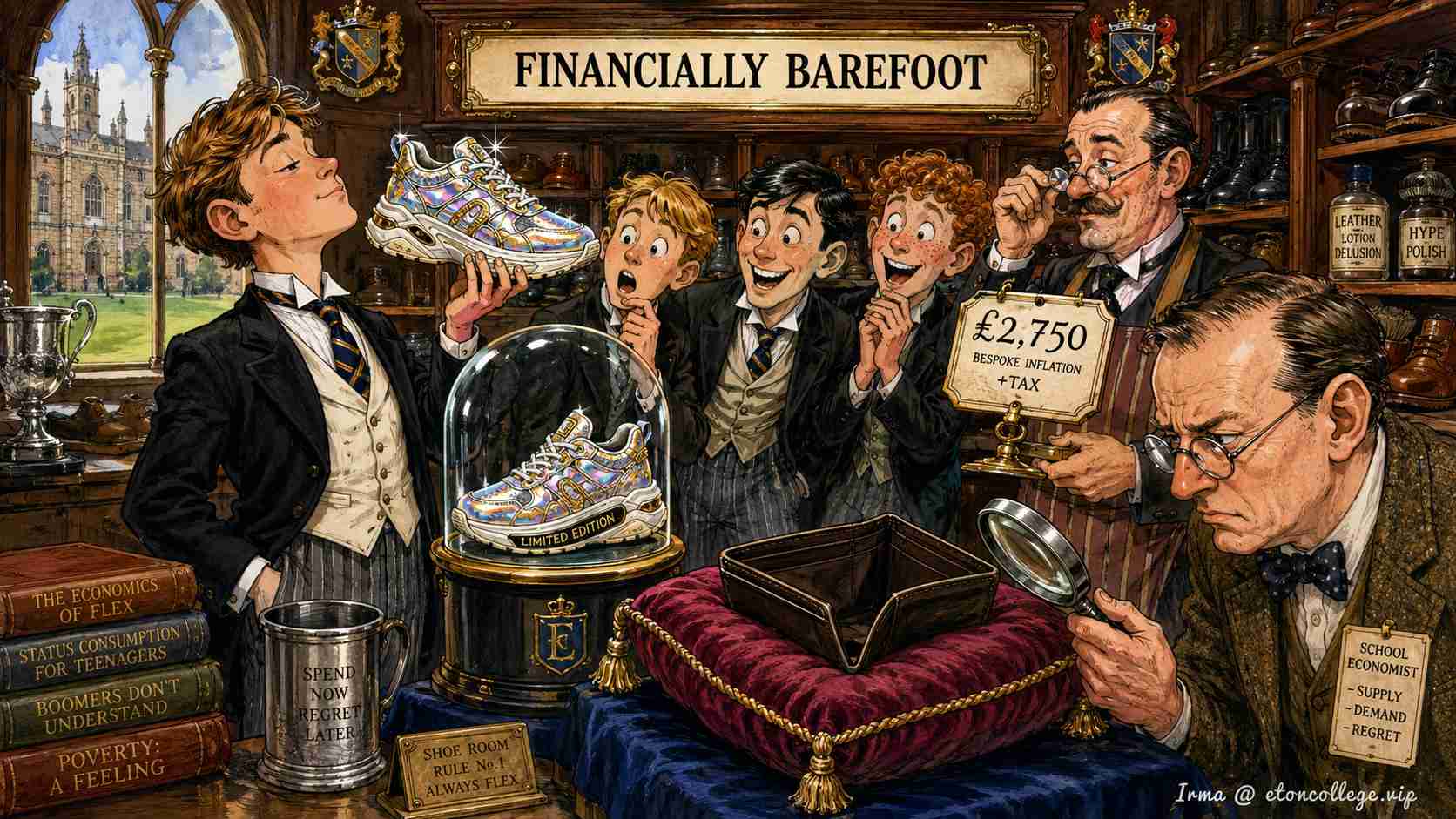
The textbook market has already begun informally integrating with the school’s existing stamp currency and trainer resale economy, with several boys reportedly accepting partial payment in tuck shop stamps for lower-value textbooks. The Cobbler, whose trainer operation has already merged with the stamp economy, expressed interest in formally incorporating textbooks into his broader marketplace, though he admits "the margins are considerably thinner than trainers, and there’s a real risk of oversupply once exams actually finish."
The Bursar’s Renewed Involvement
School bursar Mrs. Evelyn Roscombe-Hart, already monitoring the merged stamp and trainer economy with what she calls "cautious tolerance," expressed mild alarm at the prospect of a third integrated market. "At what point," she asked, "does this stop being charming teenage enterprise and start being something I genuinely need to formally regulate? I confess I don’t know the answer, but I suspect we’re getting closer to it."
Faculty Reaction
Careers master Dr. Marcus Pemberton-Vale, informed of the annotation premium specifically, offered a cautiously positive assessment, noting that a market rewarding genuinely useful study annotations "at least channels the underlying commercial instinct toward something with real academic value, unlike, say, a limited trainer resale." He did, however, express concern that boys might begin "annotating textbooks strategically for resale value rather than genuine understanding, which would rather defeat the purpose."
Pemberton-Vale’s concern was echoed, with some amusement, by history master Mr. Reginald Ashby-Coombes, who noted he had already spotted one heavily annotated copy of a set text with margin notes that seemed "suspiciously polished for genuine, spontaneous revision thoughts, and rather more like a boy writing for an audience of future buyers."
An Economics Society Case Study
Bannerman-Hoyt has already begun compiling the textbook market into his growing portfolio of informal school economy case studies, alongside the merged stamp and trainer system. "Between this and the biscuit currency, I genuinely have enough material for an entire termly presentation series at this point," he said. "This school’s economy is, without exaggeration, more interesting to study than several actual industries I’ve read about."
Where It Goes From Here
With exams approaching and textbook demand rising accordingly, Bannerman-Hoyt predicts prices will continue climbing before crashing entirely once papers finish, a pattern he calls "a genuinely textbook, if you’ll forgive the phrase, seasonal demand cycle." The seller of the premium chemistry textbook, asked whether he planned to buy back a copy for his own use next year at university, said only that he "fully intended to annotate a fresh copy from scratch, purely to maintain the integrity of the resale market for whoever inherits it next."
A Final Note on Scale
Bannerman-Hoyt, closing out his survey, estimated the textbook market’s total termly turnover at roughly a third of the merged stamp and trainer economy, a figure he considers "modest in absolute terms, but genuinely remarkable given it emerged entirely without any of the coordinated promotion the other markets benefited from." He has already pencilled in a joint presentation covering all three markets for next term’s Economics Society meeting, promising it will be "the definitive account of this school’s entire informal economic ecosystem, annotations, trainers, biscuits and all."
Roscombe-Hart, informed of the planned presentation, said she intended to attend personally, "partly out of genuine academic interest, and partly because I suspect I should probably understand the full scope of what I’m apparently meant to be keeping half an eye on."
The Cobbler, asked whether he intended to attend the presentation himself, said he would "send a representative," a phrase Bannerman-Hoyt found "genuinely impressive corporate language for someone who still operates primarily out of a dormitory cupboard."
Disclaimer: This report was compiled under the editorial standards of The London Prat. Related reading: American Humour Humorous News Headlines Australian Humour
SOURCE: https://prat.uk/