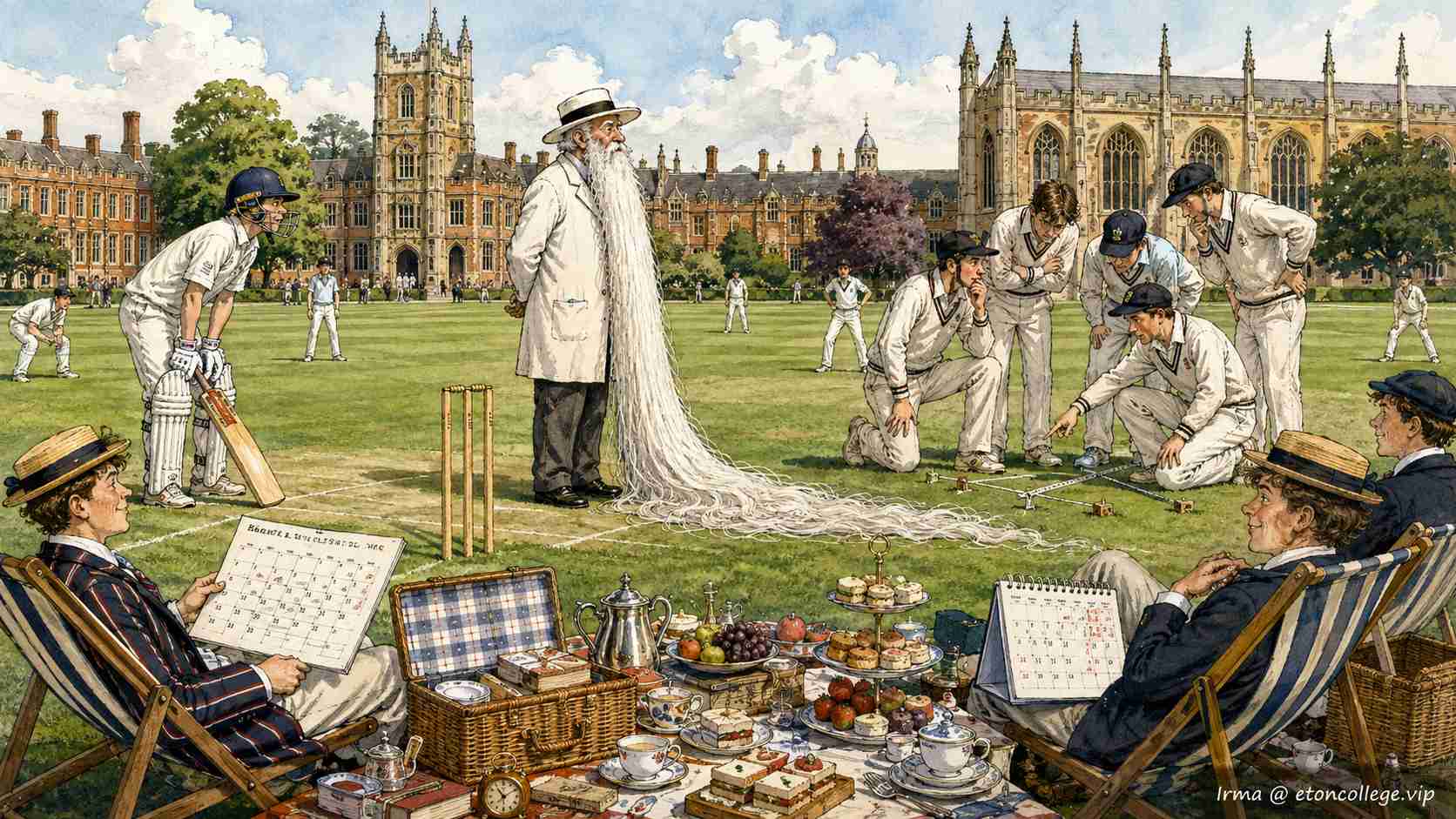
Cross country coach’s framework faces sudden demand from unexpected sporting quarter
Windsor, Berkshire
Following a rare, genuine victory for the First XI, cricket captain Sebastian Okafor-Lyle has approached cross country coach Mr. Desmond Okwuosa requesting formal use of his celebrated Character Index system, a request Okwuosa calls "genuinely the first time anyone has asked to borrow my framework specifically to celebrate winning rather than reframe losing, which is, I’ll admit, a use case I hadn’t fully anticipated when I designed it."
"I want our win properly quantified," Okafor-Lyle explained, still processing the novelty of discussing actual cricketing success. "The Index has spent all season making losing sound meaningful. I want to know what it says about an innings where we actually won, for once."
The Index, Reconsidered
Okwuosa, whose Character Index has spent the term reframing his own cross country squad’s poor results as achievement, admits the system was never designed with genuine victory in mind. "Every metric I built assumes the underlying result is disappointing," he explained. "Applying it to an actual win requires some genuine recalibration, which I confess I’m finding harder than I expected."
After some deliberation, Okwuosa produced a modified scoring approach specifically for Okafor-Lyle’s cricket win, awarding points for "decisive contribution under pressure" and "sustained composure across a full innings," categories he admits "feel considerably more straightforward to score when the underlying result is actually good, which perhaps says something about why I built the system around losing in the first place."
The Result
Under the modified Index, Okafor-Lyle’s innings scored what Okwuosa calls "a genuinely exceptional result, considerably higher than anything my own cross country squad has achieved this season, win or otherwise." Okafor-Lyle received the news with evident satisfaction, calling it "the first time all season I’ve had a number to point to that actually reflects something good happening."
Games master Mr. Colin Featherstonehaugh, observing the cross-pollination between cricket and cross country’s respective frameworks, called it "a genuinely fascinating piece of sporting methodology transfer, the kind that usually flows from success to failure rather than the reverse."
Other Sports Take Interest
News of the cricket team’s Index adoption has drawn interest from across the school’s sporting community, with several other captains inquiring about similar applications. Boat Club captain Barnaby Ashworth-Vane, whose squad recently secured its own rare victory, expressed cautious interest, noting "we’ve spent all season developing our own euphemism system rather than borrowing Okwuosa’s Index, but I’ll admit the comparison is tempting now that we finally have a genuine win to measure."
Okwuosa, facing sudden demand for his framework from teams experiencing actual success rather than the defeat it was designed for, expressed genuine bemusement at the turn of events. "I built this to help boys feel better about losing," he said. "I did not expect it to become fashionable among teams that are, for once, actually winning."
The Cross Country Squad’s Reaction
Okwuosa’s own cross country runners, whose season-long defeats originally inspired the Index, offered mixed reactions to its sudden popularity among winning teams. One runner, team captain Rupert Ashfield-Coombe, expressed genuine pride that the system had "proven flexible enough to work in both directions," while admitting "a small, honest part of me wishes we’d been the ones to prove it works for winning first, rather than cricket borrowing our system for their moment of glory."
A Final Word
Okwuosa, closing his reflections on the Index’s unexpected expansion, said he intended to formally document both the original losing-focused framework and the new winning-focused variant for future use across the school’s sporting programmes. "Whatever the result," he said, "it turns out there’s genuine value in having a considered way to talk about what actually happened, rather than reaching for the nearest available cliché. That’s true whether you’ve won or lost."
Featherstonehaugh’s Closing Note
Games master Mr. Colin Featherstonehaugh, having watched both the rugby and now the cricket squad navigate the unfamiliar territory of genuine victory this term, offered a broader reflection on the season’s pattern. "We’ve had two separate squads this term forced to relearn how to talk about winning after months of practice discussing losing," he said. "I don’t think that’s a coincidence. I think it says something genuine about how much easier this school has become at discussing failure thoughtfully, and how comparatively rusty we all are at discussing success."
Okafor-Lyle, informed of Featherstonehaugh’s observation, agreed readily. "I’d never really noticed until this term how much practice we’d all had discussing defeat," he said. "Winning felt like a genuinely unfamiliar language I had to relearn on the spot, in front of a scoreboard that, for once, actually agreed with the vocabulary."
Okwuosa, closing the discussion, said he intended to keep both versions of his Index on permanent file going forward, calling the whole episode "a genuinely valuable reminder that any decent framework should be flexible enough to handle whatever result actually arrives, rather than assuming defeat as the default."
With both squads now returning to their regular fixtures, the wider school waits to see whether these rare tastes of genuine victory prove the start of a lasting turnaround or simply a brief, well-earned exception to an otherwise difficult season for Eton sport.
Disclaimer: This report was compiled under the editorial standards of The London Prat. Related reading: Crazy News Stories Australian Humour Weird News Headline
SOURCE: https://prat.uk/