Regulating campaign posters requires a campaign of its own, apparently
Windsor, Berkshire
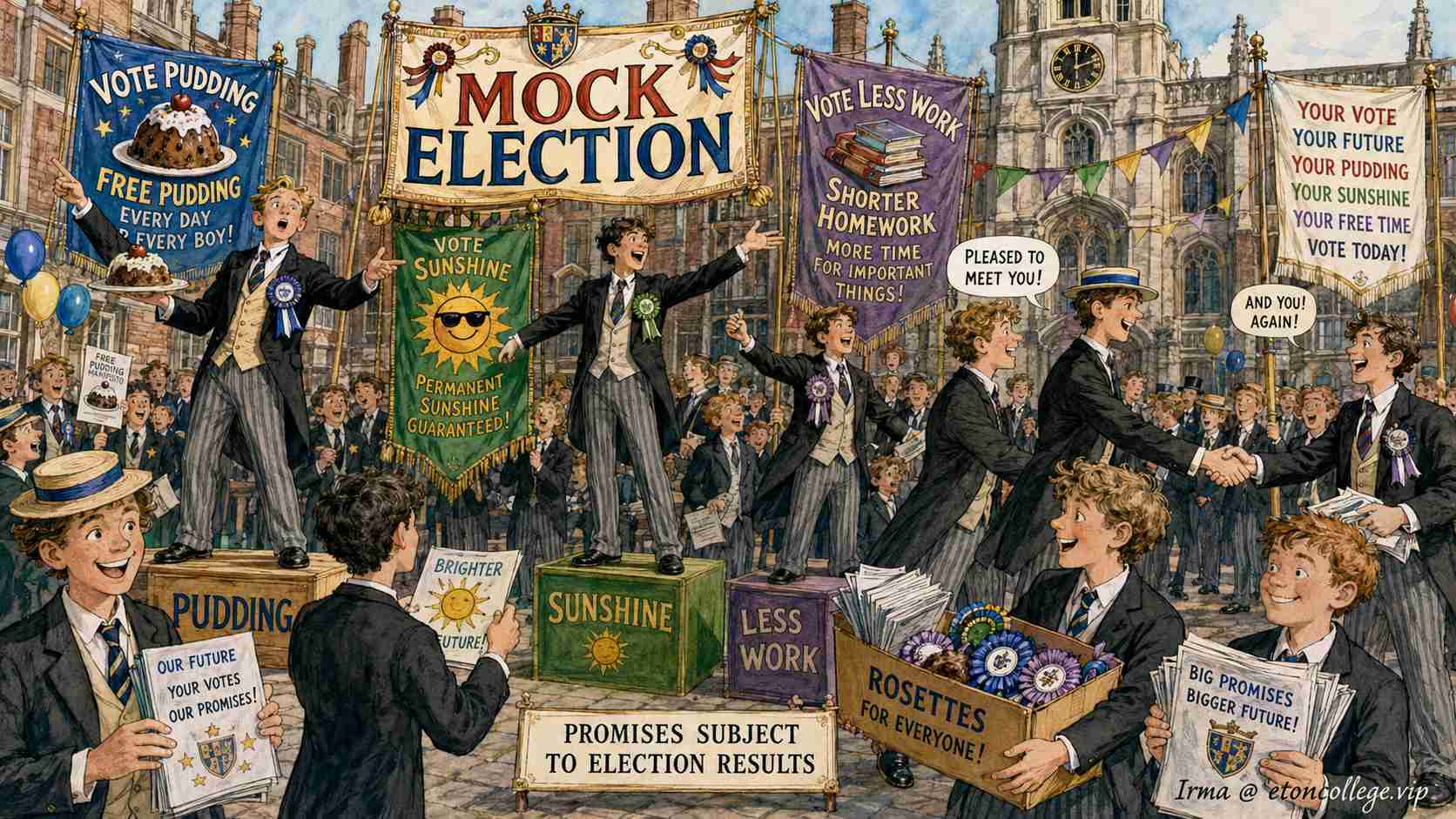
An attempt by the Eton College Student Council to establish formal rules governing campaign posters ahead of next term’s prefect elections has itself required a full electoral process, after three competing proposals for poster regulation could not be reconciled through ordinary discussion, prompting what Head Prefect Jonathan Aldous-Fitch calls "the first election about an election this Council has ever held, and hopefully the last."
The dispute began following the enamel badge controversy from last term’s prefect race, when several Council members proposed formal limits on campaign merchandise to prevent what one member called "an unofficial arms race in badges, T-shirts and, worryingly, one candidate’s brief consideration of a jingle."
The Three Proposals
The first proposal, backed by traditionalist members, called for a complete ban on all physical campaign materials beyond a single approved noticeboard posting. The second, favoured by more permissive members, proposed no restrictions whatsoever, on the grounds that "creativity should be rewarded, not regulated." The third, a compromise position, suggested a fixed budget cap for campaign materials, enforced through an honour system several members immediately questioned the enforceability of.
Politics master Mr. Edward Carrow-Sinclair, observing the resulting deadlock, called it "a genuinely perfect miniature of actual campaign finance debate, conducted entirely by sixteen-year-olds arguing about enamel badges rather than actual donations, though the underlying tension is remarkably similar."
The Sub-Election, Explained
Unable to reach consensus through debate alone, the Council voted to hold a formal vote between the three proposals, complete with its own brief campaigning period during which supporters of each position were permitted to make their case, a period Aldous-Fitch admits "became almost immediately meta, since several members began making badges advocating for the badge ban, which even I found difficult to process."
Faculty advisor Ms. Priya Ashcombe-Reid, watching the recursive campaign unfold, said she found the whole episode "a genuinely fascinating piece of institutional self-reference, the kind that would be entirely believable as a scripted comedy sketch if I hadn’t watched it happen in real time."
The Result
After a closely contested vote, the compromise position, a fixed budget cap enforced through an honour system, narrowly prevailed, securing eighteen votes to the traditionalist ban’s fifteen and the permissive option’s eight. Aldous-Fitch called the result "a genuine reflection of this Council’s broader instinct toward moderate, if occasionally over-engineered, solutions."
The losing traditionalist faction has already signalled its intention to propose a formal review of the honour system’s enforceability within two terms, a prospect Carrow-Sinclair greeted with visible amusement, calling it "entirely predictable, and honestly, I’d have been disappointed by any other outcome."
The Badge Question, Specifically
Under the new rules, campaign badges remain permitted, provided their total production cost falls within the agreed budget cap, a provision Ellery-Frost, whose own badge campaign inspired the entire debate, welcomed as "a fair compromise, and honestly, vindication of my original strategy, properly regulated."
Delacroix-Muir, whose austere handwritten-poster campaign lost the original prefect race, offered a more measured response, noting only that "a budget cap at least means future elections won’t be quite so one-sided in terms of production value, even if substance still seems to matter less than I’d like."
Faculty Reflections
Ashcombe-Reid, closing her own observations, said the entire poster rules saga illustrated something genuinely valuable about the Council’s evolving political maturity, however circuitous the path. "They identified a real problem, generated genuine alternatives, and reached a workable compromise through actual democratic process," she said. "That it took a full sub-election to regulate posters is, admittedly, a lot of process for a fairly small problem, but the underlying mechanics were sound."
What Comes Next
With the new poster rules formally adopted, Aldous-Fitch confirmed the Council will apply them starting next term’s prefect election, though he admits privately hoping "nobody finds a loophole significant enough to require yet another sub-election, because I genuinely do not think this Council’s capacity for recursive governance can sustain a third layer."
A Broader Reflection
Carrow-Sinclair, offering a final assessment of the whole saga, said he found the poster rules debate genuinely emblematic of this Council’s particular strengths and weaknesses in equal measure. "They cannot resist over-engineering a solution," he said, "but they also, eventually, actually produce one, which puts them ahead of several real deliberative bodies I could name."
The Subcommittee Oversight Panel, informed of the sub-election’s conclusion, has requested a formal report on the process for its own records, a request Aldous-Fitch greeted with what Ashcombe-Reid called "a very specific, very tired sigh I have come to recognise well this term."
Aldous-Fitch, for his part, said he intends to comply with the Oversight Panel’s request, if only, he admits, "to avoid generating a fourth layer of recursive governance purely by resisting the third." He has already drafted the opening paragraph, which, boys report, begins with the phrase "in the interest of full transparency," a phrase Carrow-Sinclair calls "the single most reliable indicator that a genuinely long document is about to follow."
Whitmore-Pryce, the Debating Society’s president, has already floated a motion for next term on the poster saga itself, tentatively titled "This House Believes an Election About an Election Sets a Dangerous Precedent," a motion Aldous-Fitch declined to comment on, citing "a strong personal need for this particular topic to simply be over."
Disclaimer: This report was compiled under the editorial standards of The London Prat. Related reading: Funny News Today Funniest News Articles Crazy News Headlines
SOURCE: https://prat.uk/