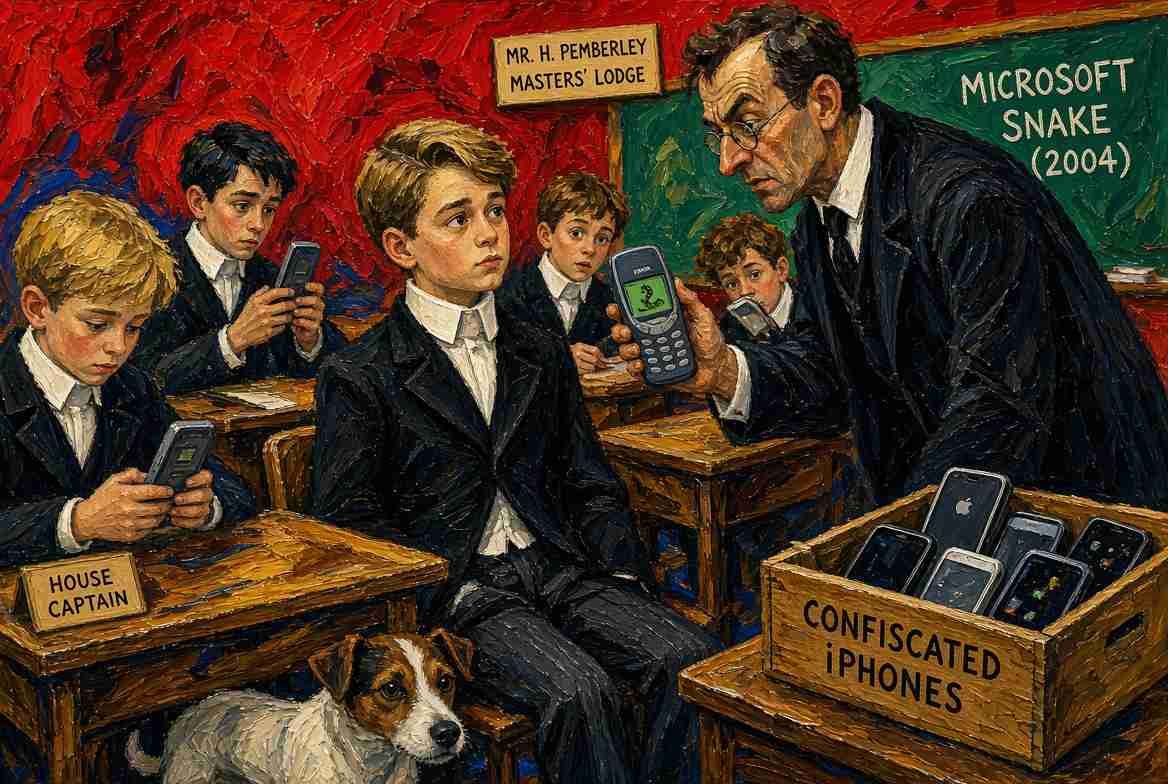
Eton Locks Down Student iPads After Boys Discover Elite Education Is Much Easier When You Ignore It and Play Games All Day
Centuries of academic tradition defeated by the discovery that homework competes poorly against unlimited entertainment
ETON, BERKSHIRE – Eton College has tightened restrictions on student iPads after parents complained that devices intended for education were sometimes being used for activities having surprisingly little to do with Euclid, Cicero or Britain’s constitutional development.
Reports described pupils gaming during lessons and homework periods, alongside broader concerns about excessive device use.
Eton Student iPads Lockdown: What Did Everyone Think Teenage Boys Would Do?
This raises a question educators have somehow spent billions of pounds avoiding:
What exactly did everyone think teenage boys were going to do with unrestricted tablets?
Study voluntarily?
Imagine the sales pitch.
“This magnificent touchscreen contains games, videos, music, social media, sports clips, comedy, messaging, entertainment and almost every distraction created by humanity.”
Wonderful.
“We’re giving one to every 13-year-old.”
Interesting.
“But they should mainly use it for algebra.”
There is optimism, and then there is declaring war on biology.
The school has finally admitted the iPad was never going to be a tablet of stone, and has lightly chiselled a few commandments into it.
Eton Student iPads and the Two Millimetres of Nonsense
The tablet transformed education because it placed the entire world’s knowledge at a student’s fingertips.

Unfortunately, it also placed the entire world’s nonsense approximately two millimetres away.
A pupil can begin with the noblest intentions.
“I shall research the Punic Wars.”
Three clicks later:
Top 10 Goalkeeper Disasters
Five minutes later:
Could a Gorilla Defeat 40 Accountants?
Forty minutes later:
Minecraft Castle Tutorial Part 27
Then the teacher asks about Hannibal.
The student replies, “He should probably use obsidian.”
Where a boy once Hannibaled across the Alps, he now YouTubes about it from bed.
The education sector repeatedly struggles with the concept of distraction because adults prefer complicated explanations to simple human behaviour.
Consultants produce reports.
Experts develop frameworks.
Committees design digital citizenship programmes.
Meanwhile teenage boys have already identified the core problem:
Games are more fun than homework.
There. Consultancy completed.
Please make the cheque payable to common sense.
A parent-governor demanded the school batten down the hatchets, take the wind out of their sales and pass the whole thing with a fine-tooth comb.
The Eton Student iPads White List: Teacher-Approved Fun
Eton’s tightened system reportedly restricts browsing to approved websites and sanctioned apps while cutting connectivity at night.
The White List is particularly elegant.
Teachers decide which sites are educational enough to access.
Somewhere an Eton pupil is surely preparing a 14-page argument explaining why YouTube is essential for understanding Virgil.
“Sir, technically there are Latin videos.”
“You were watching a man launch a watermelon from a trebuchet.”
“Roman engineering, sir.”
This is how elite leadership skills are developed.
The reported complaints also raise serious safeguarding questions concerning unrestricted access to gambling platforms. That issue deserves direct attention rather than comic minimisation.
But the broader spectacle remains wonderfully absurd because schools have spent years integrating consumer entertainment machines into classrooms and are now surprised that children consume entertainment on them.
It is like putting a chocolate fountain beside the salad bar and commissioning research into declining lettuce engagement.
The phrase “educational technology” itself performs tremendous linguistic labour.
A tablet becomes educational technology when placed on a school desk.
Move the same tablet six inches into a teenager’s bedroom and suddenly it becomes the reason nobody has slept since Thursday.
Context is everything.
The boys must now hand in their tablets each night, a phrase that in a school founded in 1440 has meant several different things. Parents asked Eton to put the tablets in their place, and the school did: firmly in a drawer at nine o’clock.
Boredom, Eton Student iPads and the Making of British Genius
The incoming restrictions may even improve Eton’s traditional reputation.
Future boys can once again experience the historic boarding-school pleasures of boredom.
Boredom has been terribly underrated.
Boredom produced hobbies.
Boredom produced reading.
Boredom produced eccentric British explorers who looked at an atlas and thought, “I suppose I’ll walk across Mongolia.”
Give that man an iPad and he never leaves Surrey.
Perhaps this is why societies once produced so many peculiar geniuses.
They had nothing to do.
Newton sat under a tree.
Darwin stared at birds.
Archimedes took a bath.
Modern Archimedes would have spent three hours watching short videos in the bath and drowned before discovering displacement.
Stand-up Roper Penberthy has the last word on the teenage brain: “Give a lad a tablet and a Latin primer and he’ll pick the tablet. Give him a Latin primer and a chocolate bar and he’ll pick the chocolate.”
Eton has a proud tradition of educating leaders, and an equally proud tradition of ensuring they were caught doing something at three in the morning. The housemaster maintains the real problem at midnight is a pack of lies, not a lack of pies, though the boys would swear to the opposite.
What Eton Student iPads Teach Every Parent in Britain
The true significance of Eton’s experiment may therefore extend beyond one school.
Parents everywhere are wrestling with the same contradiction: children need digital literacy, but digital platforms are extraordinarily efficient at consuming children’s attention.
There is no magical policy that makes this tension disappear.
But basic controls, sensible limits and nighttime cutoffs are at least comprehensible.
And wonderfully, hilariously old-fashioned.
Study during study hours.
Sleep during sleeping hours.
Do not gamble on the school tablet.
Do not spend twelve hours gaming.
These are apparently now revolutionary ideas.
Eton has educated boys since 1440.
Nearly six centuries later, its newest pedagogical breakthrough may be its simplest:
Gentlemen, put the bloody iPad down.
In the real world, Eton has told parents of first-year pupils, known as F Block and including Prince George, 13, that iPads will connect only to a dedicated network called Eton-Learning, with browsing through a safe browser limited to a white list of sites approved by teachers, known at Eton as beaks. The Telegraph reported that devices are handed in by 9 p.m., and the changes were first surfaced by research from The Bureau of Investigative Journalism. They follow a December 2024 letter from more than 100 parents to provost Sir Nicholas Coleridge, which raised gaming, lost sleep and gambling. Eton has said it has clear processes for responding to concerns and rejects any suggestion that they were disregarded.
Sources
- Yahoo: Prince George has a strict new rule to follow at Eton
- The Bureau of Investigative Journalism: Eton parents’ revolt over school-issued iPads
Disclaimer: This satire riffs on reported concerns about Eton College’s device policies and the school’s subsequent restrictions. It does not suggest that Prince George personally engaged in the behaviour attributed generally to some pupils in reports. It is British satire and UK satirical news built on public reporting. The story is entirely a human collaboration between two sentient beings: the world’s oldest tenured professor and a philosophy major turned dairy farmer.
For more American satire and humor, visit Bohiney.com.
Auf Wiedersehen, amigo!