Accidental sovereignty theory from last term formalised into full document
Windsor, Berkshire
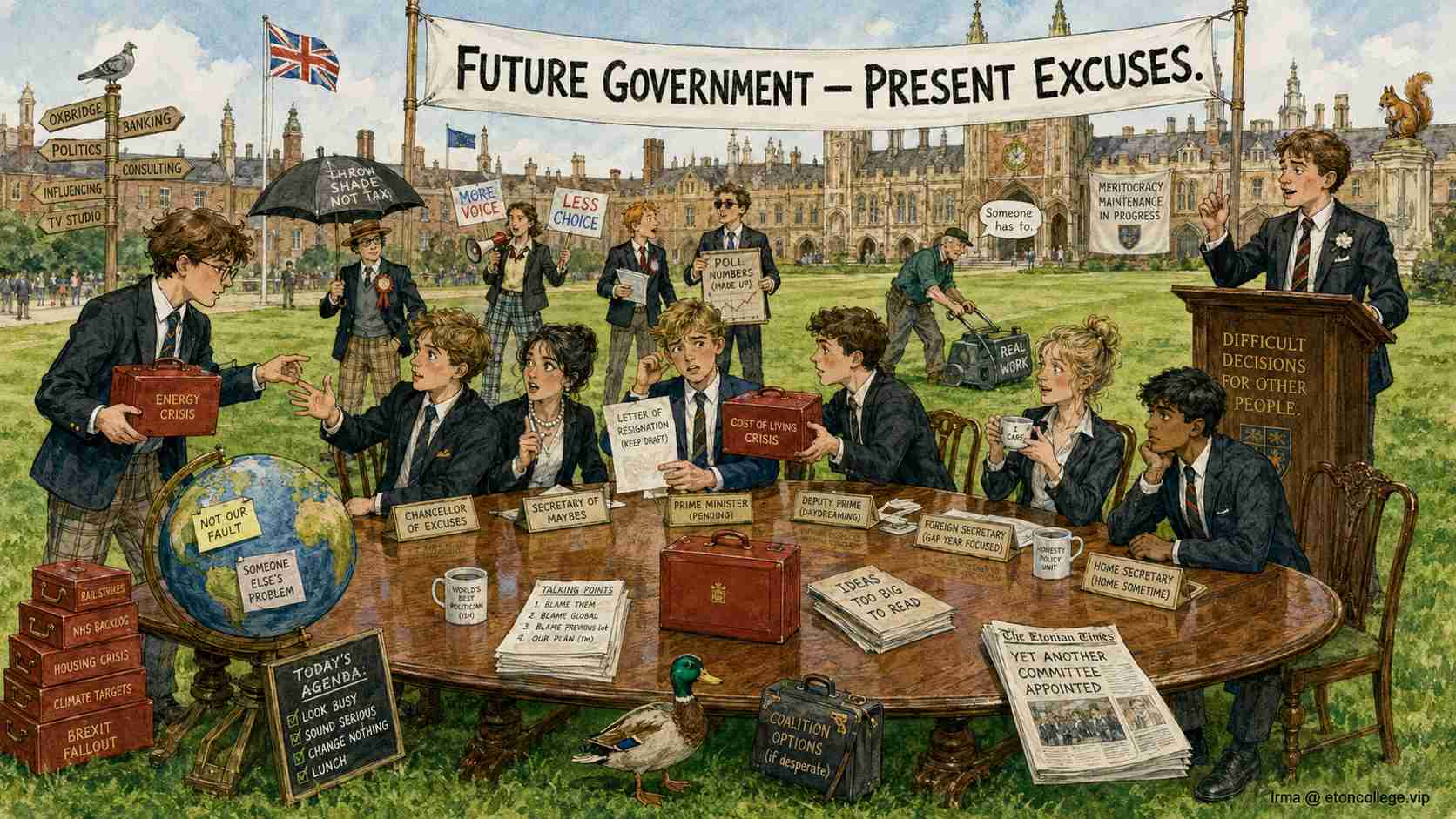
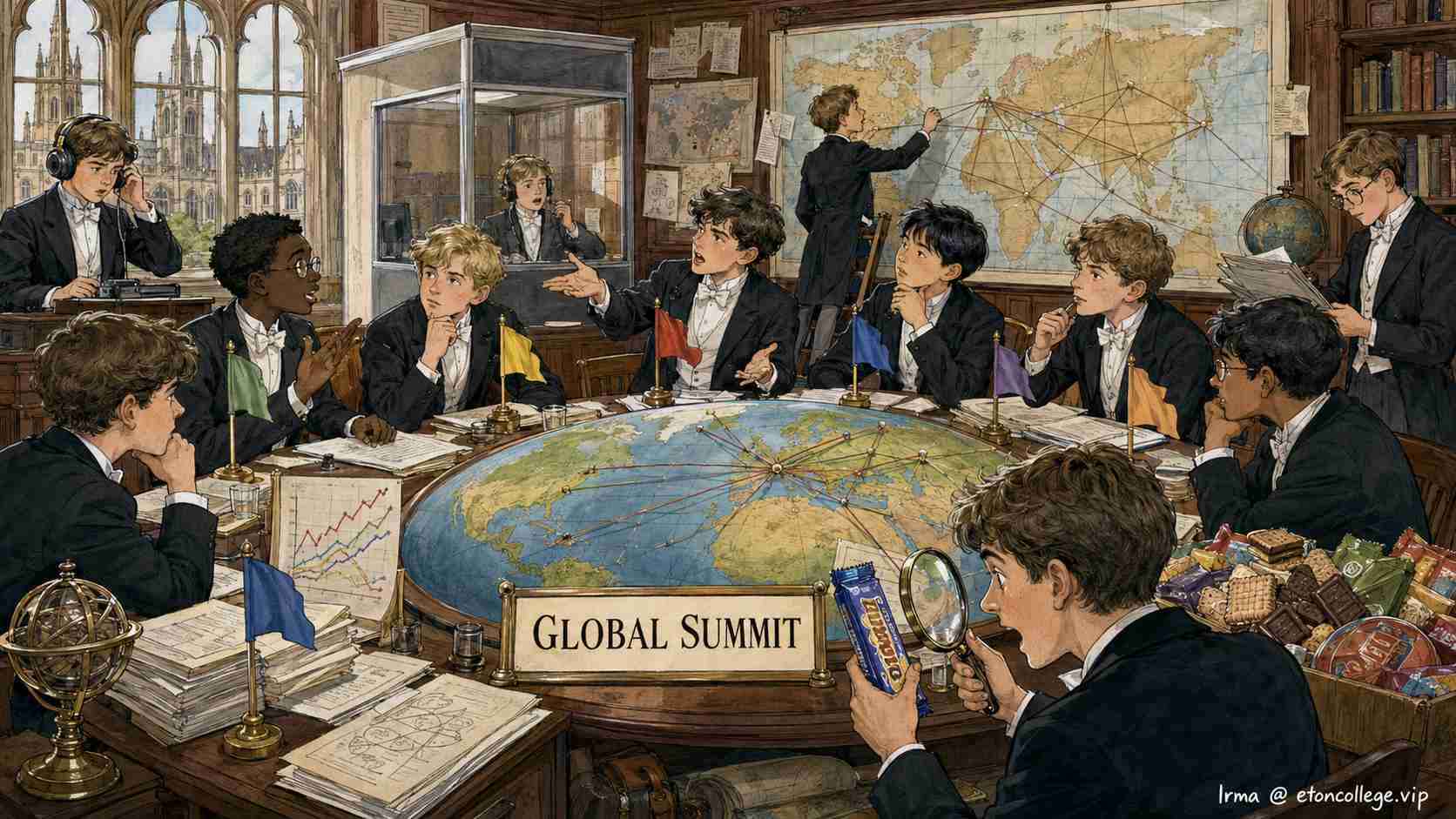
Following last term’s accidental philosophical tangent in which the Politics Society concluded the school itself functions "essentially as its own small state," the Society has now produced a full draft constitution formalising the theory, a document society president Percival Adeyemi-Cross calls "considerably more comprehensive than I expected when this started as an offhand comment from a Fourth Former."
The constitution, running to nine articles, covers governance structure, currency, territorial disputes, citizenship criteria and what the document formally terms "the constitutional status of the head of state," a section that reopens the earlier debate over whether the headmaster functions as a monarch, president or something else entirely.
The Governance Article
Article one establishes the Student Council as the school-state’s formal legislature, complete with reference to its various subcommittees, the Subcommittee Oversight Panel, and, following recent events, the newly simplified complaint procedure. Politics master Mr. Edward Carrow-Sinclair, who has advised informally throughout the drafting process, called this section "genuinely the most accurate constitutional description of student governance I’ve seen produced anywhere, precisely because it was written by people who have personally suffered through every layer of bureaucracy it describes."
The article also formally recognises the various informal economic institutions that have emerged this term, including the merged stamp and trainer currency system, the textbook resale market, and, following its recent introduction, the trainer insurance scheme, all cited as evidence of "genuine, functioning economic sovereignty."
The Territorial Disputes Section
Article four, addressing territorial disputes, formally documents both the longstanding cricket boundary dispute between Baldwin’s Bec and Godolphin and the more recent bicycle shed conflict between the same two houses, treating both as genuine examples of contested sovereignty within the broader school-state. History master Mr. Reginald Ashby-Coombes, consulted on the historical framing, called the section "a genuinely rigorous piece of internal border documentation, which I say with equal parts admiration and mild concern about how seriously this has all been taken."
The Head of State Question, Revisited
The constitution’s most contested article addresses the headmaster’s formal status, ultimately settling on language describing the role as "a hybrid constitutional position combining elements of monarchy, given its largely ceremonial authority in day-to-day governance, and executive presidency, given genuine reserve powers in matters of discipline and policy." Ashby-Coombes called this compromise "a genuinely sophisticated piece of constitutional theory, considerably more nuanced than I expected from a group of sixteen-year-olds working largely from first principles."
The headmaster himself, informed of his newly documented constitutional status, reportedly responded with good humour, according to his office, though he declined to formally endorse the document, citing "a general reluctance to be constitutionally categorised by the Sixth Form, however flattering the analysis."
Citizenship Criteria
Article six, perhaps the document’s most debated section, attempts to define school-state citizenship, ultimately settling on enrolment as the primary criterion while creating a special "honorary citizen" category for staff and, controversially, a "citizen emeritus" status for departed alumni. The citizenship debate reportedly consumed an entire additional session beyond the constitution’s original drafting schedule, with Adeyemi-Cross noting "questions of citizenship apparently generate exactly as much genuine passion in a school context as they do in actual political theory, which I found both surprising and reassuring."
Faculty Reflections
Faculty advisor Ms. Priya Ashcombe-Reid, who has watched the entire project develop from its accidental origins, said she considers the finished constitution "a genuinely remarkable piece of applied political theory, entirely self-directed, and considerably more thorough than several actual constitutional documents I’ve studied professionally." She has requested a copy for her own teaching archive, calling it "proof that the best educational outcomes sometimes emerge from precisely the tangents you didn’t plan for."
The Debating Society’s Formal Ratification Motion
The Debating Society has scheduled a motion to formally "ratify" the constitution within the Society’s own proceedings, a largely symbolic gesture society president Alexander Whitmore-Pryce nonetheless considers "an important piece of institutional theatre, even if the ratification carries no genuine legal weight beyond this room."
What Comes Next
With the constitution now drafted, Adeyemi-Cross says the Society intends to produce a laminated copy for permanent display alongside the correspondence style guide and the original school-state framework document in the Old Library, building what Carrow-Sinclair calls "a genuinely impressive body of self-generated constitutional and procedural material, assembled entirely by a group of teenagers who, I remind everyone, are still technically meant to be revising for actual exams alongside all of this."
A Closing Thought
Adeyemi-Cross, asked whether the constitution’s completion marked a genuine endpoint for the school-state theory, said he suspected it would not, noting the document already includes a formal amendment procedure "precisely because we’ve learned, the hard way, that nothing in this Society’s governance ever truly stays finished." Ashcombe-Reid, overhearing the remark, called it "probably the single most self-aware sentence produced by this entire project, which is, in its own way, a fitting note to end on."
With the laminating already scheduled and the amendment procedure formally in place, the school-state constitution now takes its place alongside the term’s other accumulated governance documents, a body of work Carrow-Sinclair says he intends to keep referencing "for as long as I continue teaching this particular brand of wonderfully overengineered political theory."
Disclaimer: This report was compiled under the editorial standards of The London Prat. Related reading: Funny News UK Crazy News Headlines Funny News Latest
SOURCE: https://prat.uk/